
The end of the era of „paper“ shareholders and new rules of the game for companies
Thailand has always been an attractive destination for Slovak and Czech entrepreneurs - not only because of its lifestyle, but especially as a strategic gateway to Asia. However, if you have heard that „setting up a company in Thailand is a formality that can be solved by an agent in a few days,“ in 2026 this statement has definitely hit reality.
From 1 April 2026 the most stringent changes to Thai commercial law in decades come into force. At iuraslovakia, we've put together an overview of what you need to know if you plan to do business there legally and safely.
Although Thai law does not strictly prohibit an individual from filing an application for registration, in 2026 it is virtually impossible to do so without a Thai-speaking attorney. DBD officials conduct verbal interviews with shareholders to ascertain their intentions and financial strength. Any hint of uncertainty or inconsistency in the documentation leads to immediate rejection of the application.
1. Basic concepts.

FBA (Foreign Business Act)
The basic law which states that foreigners (including Slovaks and Czechs) may not own more than 49 % shares in most industries.
DBD (Department of Business Development)
Thai Commercial Register. This is where it all begins and ends.

Nominee (Nominant)
A Thai citizen who „lends“ his name and owns 51 % companies, even though he hasn't actually put money into it. Warning: since 2026, the fictitious nominee (without real deposit and control) is in the crosshairs of criminal authorities.
BOI (Board of Investment)
The state authority that grants exemptions. If your business needs Thailand (tech, innovation), you can own 100 % companies legally.
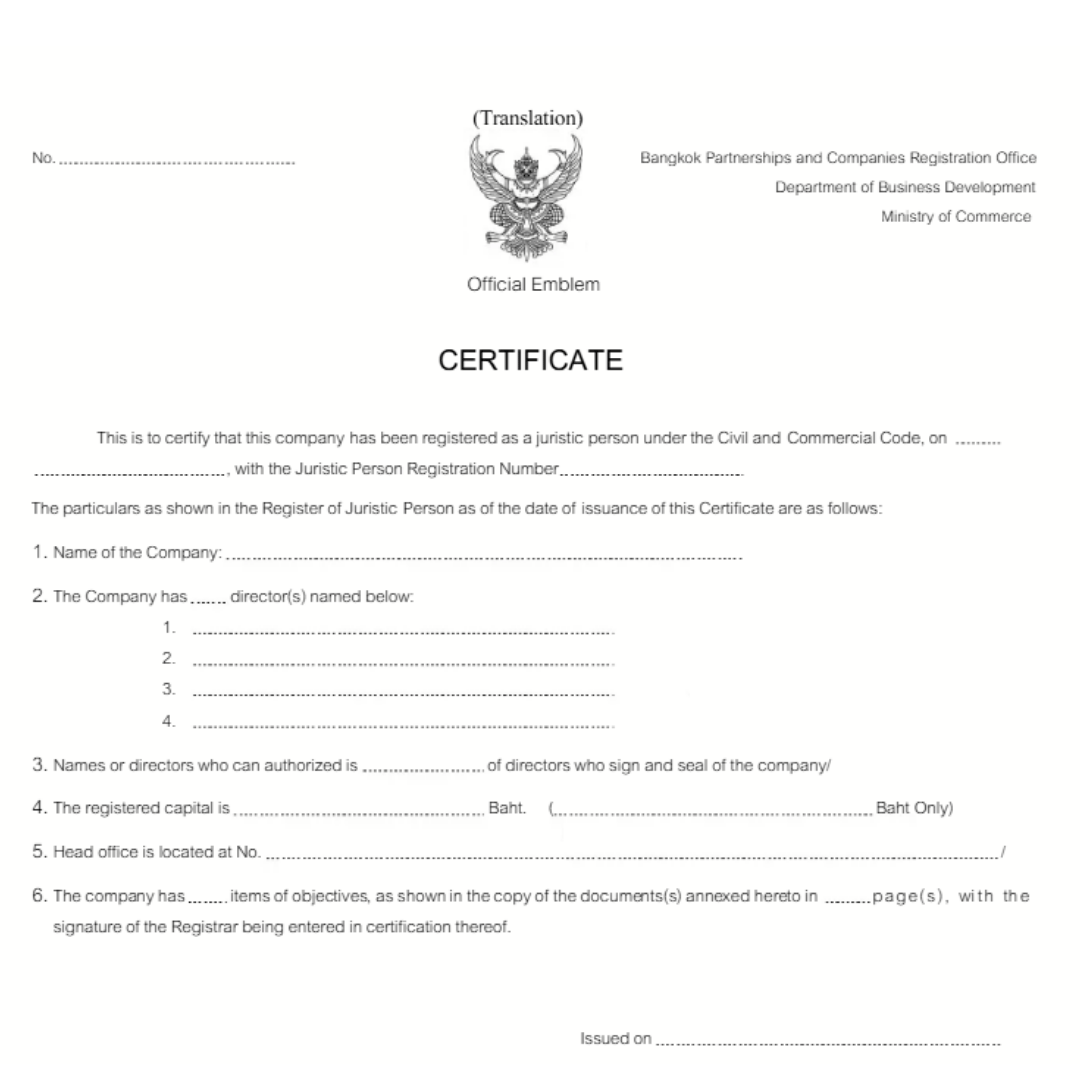
Statement Record Form
New „scarecrow“ from 1 April 2026. Affidavit of income to be signed by Thai partner.
Thai Revenue Department
Thailand's tax authority. Basically, it is the equivalent of the Revenue Directorate or the Tax Authority, which is responsible for ensuring that companies and individuals in Thailand pay taxes in accordance with the law

2. How the company formation process works (step by step, without Work Permit)
If you decide to go the mixed company (Thai Co., Ltd.) route, the following stages await you:
Name Reservation: Must be unique and approved by DBD.
Memorandum of Association (MOA): Determination of founders, registered office and object of business.
Constituent General Assembly: Approval of the Articles of Association and appointment of the Managing Directors (Director).
Company registration: Submission of documents to DBD.
Tax and VAT registration: If you are planning a turnover of over 1.8 million CZK. THB or need a Work Permit.
Required documents (for Slovak/Czech):
Copy of passport (valid for at least 6 months).
Proof of registered office address companies in Thailand (lease agreement, owner's consent).
Detailed business plan (increasingly required for structure control).
New: Bank confirmation of funds available for capital contribution.
As of April 1, 2026, if a foreigner is the sole director with signatory rights, DBD requires even stricter screening of Thai shareholders as the risk of nominee structure is considered „high“.
3. Why is 1 April 2026 a turning point?
What has changed in practice?
Personal attendance is compulsory: If you are making changes to the company (adding a foreign director or changing signature rights), the Thai shareholders and directors must appear in person at the DBD office. There is no longer anyone in Bangkok to sign documents for a „nominee“ who doesn't even know about the company.
Thai partner's financial background check: The Thai companion (51 %) must sign a declaration stating the amount of his monthly income. If the Thai „associate“ has a minimum wage but owns shares worth millions, DBD immediately launches an audit for suspected illegal concealment of ownership.
Criminal liability: Signing false information on these forms is a criminal offence in Thailand with a real threat of imprisonment for both parties.

Until now, the common practice was that the investor sent the money to the agency and the agency signed everything on the basis of a power of attorney (Power of Attorney). It has come to an end. The Thai authorities, following the recommendations of leading legal analysts (such as Sebastien H. Brousseau), have put in place a barrier against so-called shell companies.
4. Can the average person do it alone (DIY)?
Theoretically yes, practically in 2026 no longer. Why?
Language barrier: The DBD portal and most forms are in Thai. Legal nuances in translation may mean loss of control of the company.
Investment protection: The standard Articles of Association from the office will not give you control over your 49 % shares. A professional must set up priority actions, so that you have a majority of the voting rights even if you have a minority shareholding.
Link to visas: Starting a business is only 50 % of success. The second part is getting Non-B visa a Work Permit. If you make a mistake when setting up (e.g. low share capital), you will never get a work permit.
Rada iura slovakia: If someone offers you Thai companions „in a package“ without you meeting them, or claims that personal attendance at a DBD is not necessary, they are probably putting you at huge legal risk.
For 1 Work Permit for a foreigner, the company's capital must be at least 2 000 000 THB (fully paid up). This is a common beginner's mistake.
For every one work permit for a foreigner, the company must employ 4 Thai nationals.
4. Conclusion
Thailand in 2026 is no longer the „wild west“. The 49/51 model still works, but it must be real. The Thai partner must be a real partner with demonstrable income or the company structure must be treated with comprehensive legal instruments that respect the new DBD regulations.
Are you planning to expand into Thailand? Don't risk rejection of your registration or future legal disputes. V iura slovakia we will help you with the entire process so that your business is on a solid and legal footing.